
Republic of Learning Redux
March 23, 2023 by Giles Lane
Rachel Jacobs and I have recently written up a paper that explores the activities and achievements of our Republic of Learning workshops (2019-22). This post archives the previous posts about the workshops on our Manifest Data Lab website:
Republic of Learning 9: Creating a Reciprocal System
Updated: Mar 4, 2022

Our next Republic of Learning event will be on Wednesday February 2nd at 6pm London time. We will be hosting it online – using zoom.us. Facilitators: Dr Rachel Jacobs (artist, researcher) and Giles Lane (artist, researcher).
A workshop combining craft making, scientific data, intimacy, observation and stories to bring people together to imagine a human-made reciprocal and sustainable system that connects us back to the Earth’s own dynamic system (hydrosphere, geosphere, atmosphere, biosphere).
All Welcome, please book a free place via Eventbrite
Theme : Creating A Reciprocal System
AI, robots, driverless cars – machines that enable us to have “frictionless” lives and “satisfy” our every needs and dreams… What would a system look like that relies on reciprocity, sharing and gifting rather than ease, desire and consumption?
What is a reciprocal system?
This workshop will combine artistic and craft-based making to explore what a system of resilience, co-operation, re-enchantment and intimacy might be. It will bring together learning from previous sessions and work with the Earth’s planetary system (Atmosphere, Geosphere, Hydrosphere and Biosphere) to create a model for this new reciprocal system.
Materials that will help you make your reciprocal system:
- paper and/or card, pens, pencils, scissors
- any other craft or art materials you might have to hand (fabrics, string, newspaper, plasticine, paints etc…)
The workshop is free and will take place online on Zoom.
Documentation
We have created a booklet documenting the workshop, which can be viewed online or downloaded, printed out and made up into a paper booklet.
Republic of Learning 8: Little Earths, Mythical Objects & Human Stories
Updated: Mar 4, 2022

Our next Republic of Learning event will be on Wednesday December 8th at 6pm London time. We will be hosting it online – using zoom.us. Facilitators: Dr Rachel Jacobs (artist, researcher) and Giles Lane (artist, researcher) in collaboration with Dr Aideen Foley (lecturer & researcher, Birkbeck University of London).
What do we love, care for and want to protect? How would we feel about the planet – the places and non-humans that we love – if we could hold them in our pocket?
In this workshop we will make our own Little Earths, stewardship objects that combine craft making, intimacy, scientific data and stories. A mythical object to keep in our pocket, have in our home or gift to others.
All Welcome, please book a free place via Eventbrite
Theme : Little Earths, Mythical Objects & Human Stories
The Little Earths we make are based on the Russian nesting Babushka/Matryosjka dolls, worry beads and measurement cups. The Babushka doll is a folk object, nesting different sized dolls within each other to represent different layers of our selves. Worry beads act as a focus of prayer, meditation and mantras. Measurement cups are the most basic way we can measure materials to cook. Nested objects, whether inside each other or alongside each other, help us to see ourselves in relation to the world at different scales.
We will ask 8 questions. The first 4 questions will aid us to create the frame or structure of the Little Earth. These will respond to scientific data and observations at a global, national, local and then individual scale. The next 4 questions will help us explore how we might love, care and protect our Little Earth, responding to myth and folk tales. Leading us to each create a talisman for a more reciprocal future. Drawing on indigenous, folk, historic and scientific knowledge of climate, social and environmental change.
Through the act of making these objects we explore what we can gain from qualitative data (experience) as well as quantitative data (numbers) and how this can then be translated into acts of love, care and protection. Not seeking easy explanations (or judgements) but finding ways to pay attention, be present and share what our own senses and understanding of place, responsibility and change can bring.
For more about the concepts of Little Earths see: https://www.manifest-data.org/post/little-earths-stewardship-intimacy-and-community
Materials that will help you make your Little Earth:
- paper and/or card, pens, pencils, scissors
- 4 nested jars, pots, matchboxes, cardboard boxes or measurement cups or 4 different sized envelopes
- any other craft or art materials you might have to hand (fabrics, string, newspaper, plasticine, paints etc…)
The workshop is free and will take place online on Zoom.
Documentation
We have created a booklet documenting the workshop, which can be viewed online or downloaded, printed out and made up into a paper booklet.
Republic of Learning 7: Atmospheric Commons
Updated: Mar 4, 2022

“In the space between the past and future, having and losing, knowing and not knowing, lies an opportunity for awakening” (Prideaux 2021)
Our next Republic of Learning event will be on Thursday June 24th at 3pm London time. We will be hosting it online – using zoom.us. It will explore our past and present impacts on the Earth’s atmosphere – personally, locally and globally. We then seek to imagine whatever comes next… making artistic/craft based responses that combine scientific data with our own questions and stories about the future.
All Welcome, please book a free place via Eventbrite
Theme : Atmospheric Commons
We consider the atmosphere as a nebulous commons, transformed by extractivist acts of enclosure that dissipates and reforms as a material record of our politics, behaviours and histories. This collision of the sensory and the political occurs across huge scales, connecting geo-chemical processes; fossil necro-deposits; carbon industries; petroleum-states; infrastructures; service companies; governance; and energy and futures markets.
Using speculative mappings; animations, physical models and public workshops we chart the processes of planetary energy exchange that compose the atmosphere alongside the socio-technical assemblages refiguring it.
We seek to examine our personal connections to energy, distribution and consumption and develop figures, expressions and situations that ask, “Who owns the air?”
From “Political Atmospherics” by T Corby et al, in Freeport: Anatomy of a Black Box (Matadero, forthcoming 2021)
You are invited to do a simple activity before the workshop that maps your energy interactions and relationships to the complex carbon system we live within. These maps will inform what happens in the workshop as a starting off point for our dialogues and discussions. Download a PDF of instructions here:
MDL_Energy_Map.pdfDownload PDF • 7.04MB
Materials to have at hand:
For the workshop itself, we also suggest that some of the following materials would be helpful to have in place for the workshop, if you can get hold of them:
- 2-3 metal coat hangers
- Scrap textile material (e.g. old clothes, pillow cases)
- Old magazines, newspapers, birthday cards
- Cardboard, products/cereal boxes
- Blue tack, plasticine, glue, tape
- String or wool
- Other found objects (stones, shells, flowers, leaves, strange plastic things, rubbish etc…)
- A pen or sharp pencil
- Scissors
Please get in contact as soon as possible if any of this is going to be an issue and we will try and help out, or if you have any other questions about the activities or accessibility.
Documentation
We have created a booklet documenting the workshop, which can be viewed online or downloaded, printed out and made up into a paper booklet.
Republic of Learning 2021
Updated: Nov 25, 2021

After a long hiatus due to the pandemic, we are happy to announce a new series of online Republic of Learning workshop events, with the first on Thursday 24th June 3-6pm.
“In the space between the past and future, having and losing, knowing and not knowing, lies an opportunity for awakening” (Prideaux 2021)
Republic of Learning brings people together to learn about resilience in these times of planetary health crisis, uncertainty and environmental change. It presents a unique approach to shared learning that combines artistic and craft making with co-operative thinking – slowing down debate to sideline confrontation and argument in favour of gentle, collaborative deliberation. Our methods have been developed over 25 years of artistic practice and research by facilitators Giles Lane (artist, researcher), Dr Erin Dickson (artist, maker and researcher) and Dr Rachel Jacobs (artist, researcher).
Three workshops will take place in 2021 with a focus on what was normal, whatever comes next and the possibility that somewhere in between these two states sit grief, hope, resilience and the opportunity for some kind of awakening. Our aim is to plant the seeds for building an informal community that could continue to explore these issues into the future.
Workshop 1: Atmospheric Commons (24/06/2021)
In this workshop we will envision our personal, local and global impacts on the Earth’s atmosphere. We will seek to imagine whatever comes next… exploring opportunities for reciprocal and imaginative decision making in response to what we discover about our past and present impacts – by combining scientific data with our own questions and narratives about our atmospheric futures.
Workshop 2: Little Earths, Mythical Objects & Human Stories (8/12/21)
What do we love, care for and want to protect? What sadness, grief and despair are we ready to leave behind? How would we feel about the planet, the places and non-humans that we love and that enchant us if we could hold them in our pocket? In this workshop we will make our own Little Earths, stewardship objects that combine craft making, intimacy, scientific data and stories. Sign up on eventbrite here
Workshop 3: Reciprocal Systems (Jan 2022)
AI, robots, driverless cars, machines that enable us to have frictionless lives and satisfy our every needs and dreams… What would a reciprocal system look like in contrast? One that relies on reciprocity rather than desire and consumption, seamfullness rather than seamlessness, embodied knowledge rather than data? Bringing together what was learnt in the first two workshops we will build a new type of reciprocal machine to help us consider opportunities for resilience, co-operation, re-enchantment and intimacy.
All the workshops are free and take place online on Zoom.
Republic of Learning 6
Updated: Mar 4, 2022

Our next Republic of Learning session will be on Friday March 20th at 14.30 GMT. We will be hosting it online – using zoom.us – as an experiment in how to remain connected with each other, and continue to be creative and resilient in challenging times.
We will be starting at 14.30 GMT but will give people until 15.00 to download zoom and to log in. We will continue until 17.00 with tea breaks. Feel free to drop in and out.
All Welcome.
Zoom Meeting Link: https://us04web.zoom.us/j/279147110
Theme : Imagining Climate FuturesWe will bring our current theme “Imagining Climate Futures” to a close with a workshop that reflects on the relationship between Coronavirus/COVID-19 and climate futures, and whether we are now living in some kind of ‘Futuristic Present ‘. The online workshop will explore how we deal with the urgency of climate change and the ‘tipping points’ that scientists tell us will speed up climate change and make permanent changes to our world. We will also be including tipping point data (PDF slides) about the virus and what we can carry forward so that we don’t just return to business as usual after this current crisis.
Using origami paper folding we will combine the data and our personal reflections to make paper worlds that represent our actions and responses, and link across to the Earth’s climate systems: Land (Lithosphere); Air (Atmosphere); Oceans (Hydrosphere) and Ice (Cryosphere).
Participating :
You will need squares of paper and pen(s) to join in the activities. Any paper will do including newspaper, old bills etc.. Squares of paper can be made easily from rectangular sheets – we will demonstrate how. Download a simple guide to making the origami paper worlds (the “water bomb” method) or watch the video:
We have created a simple PDF worksheet that you can fill in with your ideas and responses as the workshop unfolds – or send to us later, we hope to collate these into a documentation booklet (as for previous events).

Read about previous events : https://www.manifest-data.org/blog/categories/republic-of-learning
Documentation
We have created a booklet documenting the workshop, which can be viewed online or downloaded, printed out and made up into a paper booklet.
Republic of Learning is facilitated by Erin Dickson, Rachel Jacobs & Giles Lane and is part of the AHRC-funded, “Materialising Data, Embodying Climate Change” project based at Central Saint Martins UAL.
We will be taking a break in April and continue in May with a new theme: ”Sharing a more-than human world”.
Republic of Learning 5: Imagining Climate Futures
Updated: Mar 4, 2022
Last Friday we held the fifth Republic of Learning workshop and second in our current theme of “Imagining Climate Futures”at MAKE at Story Garden. We are continuing to use art, crafts and model making as a way to share ideas about how we can respond to climate impacts – to frame and host conversations about futures that many are finding bleak and frightening as the news remains full of stories about extreme weather events, disturbing natural phenomena and sudden changes to the usual patterns in our climates and environments.
The aim of the workshops is to establish a creative and convivial space in which people can come together to discuss these issuesand to explore together what sort of responses to climate impacts we can have, whether they have expert knowledge in any related field or are just curious or concerned. Using craft and makings skills as a vehicle for conversation changes the dynamic (from more traditional discursive spaces) by slowing things down and providing a focus on attending to the material world instead of the purely abstract world of ideas and opinions.
From working with felt to create ‘climate emblems’ in our last workshop, we shifted to working with clay to manifest ideas. The very different material qualities of clay, and the need to work directly with the hands – to knead and work it, keeping the clay moist and pliable – makes this activity a more contemplative one. It took place during the school half term, and so we had been advised that there may be families attending as part of the “Busy Hands” week across the StoryGarden. We adjusted our plans so that the workshop could accommodate people of different ages dropping in and just making things without needing to get engrossed in the more complex aspects of the theme.
We identified three key climate impacts – fires, storms and changes to the seasons – which people could respond to, each of which have either been in the news (e.g. the extraordinary Australian bush fires) or which we have had direct experience of, such as the recent series of storms to batter the UK (Ciara & Dennis) or the early onset of Spring as visible in blossoms and flowers appearing from late January through February, many of which are a month or six weeks earlier than usual.

What we think these Republic of Learning workshops enables is a space in which we can begin to explore these questions not just from a personal perspective, but from a more collective dimension. What will it mean for us to become ‘resilient’ in the face of the kinds of impacts and changes that may be wrought upon us as climate change becomes the ‘new normal’? How can we feel a sense of empowerment to cope with changes – social, cultural, political, economic, environmental – by facing these together, as communities and not just as isolated individuals for small family units?


The conversations flowed from highlighting personal responsibilities in our contribution to climate change (the ‘carbon footprint selfie camera’) to ideas for making better use of existing social infrastructure for homeless people who may need temporary shelters during the increasingly frequent storms, to ways to better share the excess materials (‘waste’) from local industrial or artisanal production for making new things, to placement programmes for urban dwellers to spend time in nature working on projects to restore or re-wild natural environments – thus connecting with and gaining a direct experience of nature and natural forces, to having rural dwellers take part in urban projects to ‘green’ our towns and cities, on similar placement-style schemes.

In addition to the Thinksheet above – for which one of the facilitators acts as scribe and tries to capture ideas and themes emerging during the workshop – we also devised a simple worksheet for participants to self-document their own creative activity and ideas:


And below are some photos of the objects made:


Documentation
We have created a booklet documenting the workshop, which can be viewed online or downloaded, printed out and made up into a paper booklet.
Our next Republic of Learning is on Friday 20th March 2.30-5pm at MAKE@StoryGarden. Sign up for as place at : https://republicoflearning.eventbrite.co.uk/Everyone is welcome.
Erin Dickson, Rachel Jacobs & Giles Lane
Republic of Learning 4: Imagining Climate Futures
Updated: Mar 4, 2022

The first of our Winter 2020 series of Republic of Learning sessions took place on Friday 24th January at MAKE@StoryGarden in Somers Town. The focus of this series is ‘Imagining Climate Futures’ : using art, crafts and model making as a way to share ideas about how we can respond to climate impacts.

It is clear that, whilst almost all humans are contributing in some way to the emissions caused by mass consumption and the increasing industrial extraction of natural resources, the effects are felt asymmetrically across the globe. The cumulative effect of increased carbon in the atmosphere (amongst other factors) is itself distributed globally, but the effects and impacts which this causes are local and particular to specific environments and ecologies. We are seeing very different impacts – from the unprecedented bush fires in Australia, to flooding in Indonesia, severe storms across Southern USA and, of course, Storm Ciara which has only just hit the UK with tremendous force.
In our workshop, Erin, Rachel & Giles facilitated a creative and convivial space – primarily working with felt – in which the participants were asked to collectively create a series of ‘climate emblems’. The emblems are built up collectively over five stages. Each participant starts with a blank circle of felt and adds elements in response to a series of questions. At the end of each making stage, they describe what they have done, and pass their emblem to the next person. Then, receiving one from the person next to them, they continue with the next stage, before describing what they have added or changed and passing it on again.


The workshop has a specific workflow of intense making activities punctuated by animated discussions – everyone takes turns to speak, and there is space for conversations to flow between participants. Not only that, but there is a high degree of collaboration and sharing of skills as people assist each other with practical tasks of cutting and making. We also see people being stimulated by other participants’ creativity to challenge themselves and expand their own repertoires of making and expressing themselves through materials. At each stage the participants add to, or adapt something the person to their left has made, and this builds up into a complex, shared visual and tactile expression of ideas. The resulting emblems are assemblages of highly personal responses, yet collective too.


What has been intensely interesting are the transitions that happen during the workshop as people arrive with ideas and feelings that, through the process, can shift or change. We have seen people arrive with feelings of despair and despondency caused by the climate crisis or emergency (sometimes referred to as “eco-” or “climate-anxiety”), engaging in the creative expression and sharing of ideas to find themselves feeling positive and inspired at the end. Others have come and experienced a growing awareness of connections and interdependencies that they had been unaware of before. Almost everyone who has taken part (either in last week’s session or the previous one Rachel & Giles ran at Camden Think & Do in November) spoke of how the process enabled them to gain wider perspectives on the range of issues and possibilities that climate change represents – not just interns of its effects, but how and what we might choose to become involved in to make our own contributions to change.
A key to this discussion is our use of Mike Hulme’s “climate myths” from Why We Disagree About Climate Change, counterposed with the framework suggested by George Marshall in Carbon Detox. As a framework they offer participants recognisable tropes and types to work with, as well as indicating where gaps and places or spaces in between might exist:

As the workshop progresses and conversations unfold, we are using a worksheet – in the shape of clouds – to document key questions, feelings and ideas that emerge:

These are clustered across four regions – represented on the worksheet as individual clouds. As a guiding framework we have been using the quartet of “Known knowns; Known unknowns; Unknown knowns; and Unknown unknowns”. These also relate to the four quadrants of the Johari window, a psychology tool used in helping explore and define relationships between the individual and others. Our rationale for using this framework is similarly to map and explore the relationships between the things we are certain of (known knowns); things we are uncertain of, but where we can perceive gaps to be (known unknowns); the tacit knowledges, skills and experiences which we have but do not always acknowledge as such (unknown knowns); and finally, those things about which we have no knowledge or experience at all and which are beyond our horizon of perception (unknown unknowns).
In addition to the visual and tactile elegance, playfulness and sheer creativity of the climate emblems, the “Clouds of Knowing and Unknowing” worksheet helps situate and share some of the key conversational elements that flowed throughout the workshop. As an unfolding map of feelings and ideas it helps participants and facilitators to visualise the emerging gaps to be bridged and to identify emerging themes and commonalities.
Over the next two sessions we will continue to explore what kinds of responses we can make that could close the distance between our situation here in London – in Kings Cross and Somers Town – and those of others elsewhere in the world. We will build on the climate emblems by devising models for imaginary climate futures in which humans can not only survive, but thrive and cope with the complex spectrum of changes that lie ahead of us. We plan to show the material outcomes in a pop-up exhibition during the summer.
Documentation
We have created a booklet documenting the workshop, which can be viewed online or downloaded, printed out and made up into a paper booklet.
Book a place on our next sessions.
Everyone is welcome. Come to any or all of the sessions.
Erin Dickson, Rachel Jacobs & Giles Lane


Climate Change Cross Stitch

Our third Republic of Learning event took place on Friday 15th November at Make@StoryGarden, and was intended to explore a different mode of exchange through a focus on making.
The first two RoL sessions had featured objects being shared and discussed as a vehicle for exploring the intersections between art, culture, science and climate change. Following feedback from previous sessions, we decided to place a greater emphasis on making as an activity to promote more relaxed discussions around the core themes. The third session developed from the basis of craft as reminiscent of digital process, in this case with cross-stitch employing a 0/1 approach across a predefined grid which could be utilised to communicate graph-like imagery through pixellation. Although the intention was to provide a new way of looking at local data, interpreted through making, we also aimed to combine some of the ubiquitous styles used in traditional cross-stitch. This included pre-defined floral decoration, as well as an invitation for participants to create an equivalent of the idiom ‘Home Sweet Home’, which we termed ‘Personal Climate Mantras’.


Cross-stitch is often considered a feminine activity and referred to as one of the ‘domestic’ arts. Typically cross-stitch patterns, once completed, are used as décor and framed, or made into throw pillows for sofas or beds. This translation of data takes a complex subject like climate and grounds it back into the space of the vernacular and domestic.
Erin had come across the TEDx video by Sarah Corbett on how “Activism needs introverts”. In this video she discusses her experiences of working in activism and how activism, of any sort, tends to prioritise extrovert activities, such as campaigning and marches. She makes a case for finding ways in which people who are not comfortable with extrovert activities can be incorporated into activism using quieter, more contemplative approaches. Cross-stitching/embroidery can create a relaxed space for open discussion – makers can discuss harder topics without eye-contact, creating a more inclusive environment. The results can form powerful objects that can communicate with policy makers and others in inclusive and non-confrontational ways.
Rachel brought data from the Met Office she has worked with before, namely the “Mean Central England Temperature Anomalies” from 1659 to 2019. This graph indicates the range of anomalies in temperature measurements over a 360 year span, as well as indicating the mean anomaly. This (the mean anomaly) she converted into a simple cross-stitch pattern and placed at the top of the planner (above) which we created for participants to follow.

The bottom design shows Euston Road, Chalton St and Eversholt St with different colours showing the differences between the pollution levels around Kings Cross and Chalton Street. The different shades of colours shows the levels of air pollution. Euston Road has the worse pollution, a lot higher than recommended limits, whereas Chalton Street is at the limit. The data was taken from Kings College’s LondonAir site, which collates data and visualises it from street-level pollution monitoring stations across London.

Our intention for this session had been to use a making activity as an alternative and convivial ‘prop’ that could allow conversations to flow in a more relaxed and reflective style. Previous sessions had used objects (from both Rachel’s & Giles’ prior artworks) as the props for the discussions, but we had found that a familiar style of debate was still arising that a number of participants expressed discomfort and dissatisfaction with. We knew already from other workshop and meeting experiences that when participants are engaged in practical making activities, their attention is punctuated by the craft process itself, slowing down and attenuating the exchange of words from a debate into a conversation.
Only one of the previous participants attended this event (it was the least well-attended of all the sessions so far), and by making a physical correlation between local pollution data (the air quality measurements from the nearby Euston Road monitoring station) and the climate data drawn from the Met Office’s temperature anomaly data for central England, we could entice more local people in to join us. We didn’t manage to do so quickly enough for this event (building trust with local communities is a slow business), but our intention is to retain the cross stitch activity as a thread running through future Republic of Learning events that people can drop in and take part in, a gentle yet expressive way for people, especially locals, to be part of these evolving conversations and to contribute to them in ways which are tangible.

Erin’s cross stitch (above) adds flowers to the air quality data, beneath the words, “When is Enough?”– a question provoked by Giles’ when quoting the American poet and environmentalist Wendell Berry, “To make a living is not to make a killing but to have enough”.
We will be running more Republic of Learning sessions at Make@StoryGarden in 2020, starting from Friday January 24th at 2.30pm. Followed by Friday 21st February and Friday 20th March – all at 2.30pm until 5pm.
A Republic of Learning

These are uncomfortable times, full of disconcerting facts, chilling implications and uncertain outcomes. – How do we respond to problems that are on a planetary scale? – How do we affect systems and processes that scale way beyond the reach of our own hands? – How do we step aside from feelings of despair that is commonly engendered by incipient knowledge of the enormity of the changes already afoot?
We do so by coming together, talking and making things – sometimes objects, sometimes decisions. We do so by sharing what we have and know, as well as what we do not know. We do so by engaging our imaginations and making real – bit by bit – another world. We do so by defining resilience within ourselves, our communities, our actions and intentions – by attending to the local as well as the global. In this way we achieve a common wealth of ideas, stories, tools and techniques – of fellow feeling and support against impending tragedies. Each time we wrest other small piece of sovereignty away from those who would subject us to further to unfeeling systems of control and we make our own republics of learning, knowledge and community – in which we are all citizens.
A Republic of Learning is a new monthly meeting space for exploring and discussing the role of art-making, data science and climate change and making things in response. It aims to address the local to global, to challenge experts and non-experts to learn together and share questions about how to make sense of the transformational changes ahead of humans, ecosystems and other lifeforms on the planet. To make responses together, outside of the habitual spaces in which we act.
Our first meeting, last Friday 20th September, coincided with the Global Climate Strike in which millions of young people and others around the world took part – demonstrating for action on climate change. We gathered to make our own contribution to action – starting something we hope will grow over time and become a space for people to come together to share and learn together.


To get things started, Rachel Jacobs brought in some objects from various art works and projects and talked about her practice and how it has engaged with places, environments, communities and ecologies over the past decade and more. The objects provided us with tangible things to discuss among ourselves and think about what our own contributions to positive and purposeful transformation could be, especially as some of us had children participating directly in the marches and actions happening at the same time.


The monthly meetings – held on the 3rd Friday of the month (10.30am to 1pm) – will take place in The Story Garden, a new community space in Somers Town behind the British Library and next to the Francis Crick Institute, made by and for the local people and managed by Global Generation. We are generously hosted by Make @ Story Garden, a public engagement project of Central Saint Martins UAL.
The concept of a republic of learning is borrowed from Fred Garnett, who conceives of The Republic of Learning as a “post-Enlightenment” rethinking of self-determined learning spaces and communities outside of the academies and learned societies that have dominated learning and teaching for centuries. His concept harks back to Erasmus who, in the 1500s, declared himself a “citizen of the Republic of Letters”.
Our Republic of Learning is convened by artists, Rachel Jacobs, Erin Dickson and myself as part of the engagement activities of the Manifest Data Lab – a new transdisciplinary group based at Central Saint Martins who are exploring art, data manifestation and climate change. The format for the meetings will be open and fluid – no formal presentations or workshop structures, but instead a place where conversations can emerge and evolve. We hope to grow a community of people who want to address these issues through the lenses of creativity, in partnership with the insights offered by science and the possibilities of technologies, new and old.

Special Offer on UnBias AI4DM Toolkits
June 2, 2021 by Giles Lane

In hopeful anticipation that once again soon people may begin running in-person workshops and activities, we are offering manufactured sets of the UnBias AI4DM Toolkit on SPECIAL OFFER at 66% off the usual price.
At the moment we are delivering within the UK only. Please contact us for international shipping estimates.
The toolkit is designed to bring people together from across organisations to map out the cooperative and intertwined nature of ethics and governance from multiple perspectives when designing and deploying – or evaluating – AI and Automated Decision Making systems.
Explore both the UnBias Fairness Toolkit and UnBias AI4DM here.
Inclusive Security
March 4, 2021 by aliceangus
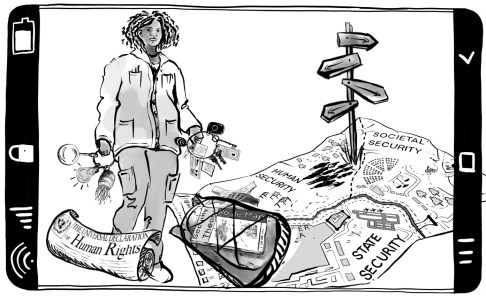
We have been collaborating with Professor Lizzie Coles Kemp, (of the Information Security Group, Royal Holloway University) and the communities she works with, for several years, on projects about bias, access, security, exclusion, privacy and consent in digital services. Lizzie is groundbreaking, and inspiring, in the way she collaborates with communities, artists and performers in this work.

Recently I’ve been excited to be working with her using my process of ‘drawing as research’, to reflect on her work, and to bring in moments, expressions and feelings that are sometimes beyond words. It’s is not about me illustrating the research; my drawing and Lizzie’s writing inform and influence each other as an iterative creative process. Some drawings only exist temporarily to explore an idea, but many develop into final works.
The first set of drawings were part of Lizzie’s Inaugural Lecture “Digital security for all: why an inclusive security approach matters”. More recently she commissioned a large collection in response to her significant body of research on the way our interactions with digital technologies are shaped; her call to recognise the political and social power of security technologies; and to reform them in terms of trust, inclusion and reciprocity. They were created around exchanges we had during the writing of her book “Inclusive Security: Digital Security Meets Web Science” – (part of the Foundations and Trends® in Web Science series by Now Publishing). Many of them appear in the book and together they form a large body of artwork Lizzie can draw on for publications, teaching, lectures, and events.
“Alice’s artwork draws out the complex and contradictory details of everyday life. Every line in her drawings writes back in the feelings and experiences of technological security use that academic writing so often struggles to articulate.” Lizzie Coles Kemp

“Digital security for all: why an inclusive security approach matters”
“Digital security for all: why an inclusive security approach matters.”
UnBias AI4DM Sets available now
November 23, 2020 by Giles Lane

If you missed our recent crowdfunding campaign we now have a limited number of first edition sets available to buy. Purchase copies direct here, or contact us [sales at proboscis dot org dot uk] if you wish to order multiple sets.
Proboscis is also offering a 1-2-1 Facilitation Training package (2 x 1.5 hour video call sessions plus a Personalised Facilitator’s Guide) and a Bespoke Workshop Planning & Facilitation service using the toolkit for your organisation.
Please contact us [sales at proboscis dot org dot uk] for details and prices.
UnBias AI4DM Teaching and Learning video
October 17, 2020 by Giles Lane
A brief animation with some ideas for using the UnBias AI For Decision Makers in online and in-person classes. Watch our other animations here.
UnBias AI4DM Running a Workshop video
October 17, 2020 by Giles Lane
A brief animation with suggestions for how to run a workshop using the UnBias AI For Decision Makers Toolkit. Watch our other animations here.
AI For Decision Makers
September 15, 2020 by Giles Lane

Our practical ethics and governance toolkit for AI and automated systems is now available to download in a DIY print-at-home version, and we are running a crowdfunding campaign on Indiegogo for a production run to make the toolkit widely affordable.
Download the FREE AI For Decision Makers Toolkit (Zip 11Mb)
AI4DM Worksheet only (PDF 400Kb)
Read the Handbook Online
Order your set now from our online store
“Quite frankly this is the best bit of communication in this area I have ever seen. It is the perfect complement to the UnBias Fairness Toolkit. Together they can be adopted by any organisation in business, charity, education, healthcare etc etc.
Lord Clement-Jones CBE
Especially in the light of recent events I just wish that every member of the Government and the Civil Service had a set!
I know how difficult it is to refine the language so that it really gets through. You have done a superb job.”
Chair of the House of Lords Select Committee on Artificial Intelligence (2017–2018)

AI4DM is a suite of critical thinking tools enabling cross-organisational stakeholders to implement transdisciplinary ethical and governance assessments of planned or existing AI and automated decision-making systems.
It naturally fosters participation, bringing people together to map AI systems, existing and proposed, against the organisation’s own mission, vision, values and ethics.
It uses a whole systems approach to analyse organisational structures and operations, illuminating to participants the breadth of issues beyond their individual responsibilities.
The tools are intuitive, practical and can be used for:
- revealing where and how a system is either in alignment, and where it is (or could be) misaligned with the organisation’s mission, vision, values and ethics;
- enabling different stakeholders to appreciate where and how their obligations and responsibilities intersect with those of others.
- emphasising the collective nature of lawful and ethical responsibilities across the whole organisation
- providing a mechanism for a deep analysis of complex challenges.
The toolkit was conceived, created and designed by Giles Lane with illustrations by Alice Angus. It was commissioned by Ansgar Koene at EY Global Services.
Download the Flyer (PDF 80Kb)

Manifest Data Lab
February 14, 2020 by Giles Lane

In mid-February 2019, Professor Tom Corby (CSM) and Giles Lane (Proboscis/CSM) co-founded the Manifest Data Lab, a transdisciplinary research group based at Central Saint Martins, University of the Arts London. The group also comprises Professor George Roussos (Birkbeck University of London), a long-time collaborator of Proboscis, and Dr Louise Sime (British Antarctic Survey) and formed to develop the 3 year AHRC-funded research project, “Materialising Data, Embodying Climate Change“.
Over the past year we have recruited a team of two Postgraduate Research Fellows: Dr Erin Dickson and Dr Jonathan Mackenzie; and two Visiting Research Fellows: Gavin Baily and Dr Rachel Jacobs. The team’s research has delved deeply into how data is collected, analysed and modelled for creating the Earth Systems Models for climate change, gaining understandings of the sheer complexity of data types and methods used to interpret the science of climate change. We are now beginning to identify what data sets to focus on for our materialisation experiments, and exploring techniques for identifying and extracting salient features from extremely large datasets using machine learning methods. This is intended to inform the processes by which we use climate data to drive the generation of 3D forms.
A corresponding materialisation research strand has focused on exploring techniques, materials and technologies that are effective and appropriate for working with data in multiple ways. From experimenting with polygon reduction in 3D printing in a range of materials, to slip casting clay vessels and dissolving them in solutions, to creating blown glass bell jars in a hot shop for mini-environments that scorch their contents as a metaphor for global warming.
In addition, MDL has developed a public engagement programme, Republic of Learning, alongside our research activities, which aims to engage a wide range of publics in creative and convivial processes beyond the confines of academia. We have partnered with CSM’s public MAKE programme to host our events in the Story Garden community space in Somers Town, London.
In 2020 we are developing an exciting body of work that we hope to launch around the time of the COP26 climate meeting in Glasgow – one which we hope will draw together the many strands that we have been working on and which will fulfill our goal of exploring how artistic practices and the materialisation of climate data can provide empathic encounters and stimulate new ways for people to engage with the impacts and consequences of climate change.
UnBias Facilitator Booklet
July 3, 2019 by Giles Lane
Our colleagues, Helen Creswick and Liz Dowthwaite, at Horizon Digital Economy Institute (University of Nottingham) have recently produced a new booklet for facilitators to accompany the UnBias Fairness Toolkit.
The booklet is the result of an Impact Study grant to run a series of workshops with people of different ages and to co-devise games and activities using the Awareness Cards. It also contains further advice and feedback for facilitators and other running workshops using the Toolkit, to guide them to what works best with different groups.
Download PDF versions to print out and make up
City of Refuge Toolkit
May 10, 2019 by Giles Lane


This is a co-creative and participatory toolkit of relevance to researchers, civil society and institutions working with newcomers, migrants, refugees and those supporting them (citizen actors and organisations).
The City of Refuge Toolkit aims to explore the needs these actors have: such as the resources they need, and the obstacles they face when they try to build inclusive, safe and equitable local and national communities and spaces. The toolkit brings people together to discuss and share their experiences, to build connections and find common ground. It asks participants to identify what an ideal City of Refuge would need to be a reality (the ‘ideal’ city of refuge could be adopted from neighbourhood-level to national level).
The toolkit contains:
- Individual Task Sheets
- Group/collaborative Work Sheets
- A Workshop Facilitation guide for working with refugees/newcomers
- A Workshop Facilitation guide for working with citizen actors
- A Materials Guide suggesting icons and images for stickers
It is available in four languages – Arabic, English, German and Greek.
The toolkit has been devised and created by Giles Lane, with Myria Georgiou, Deena S Dajani, Kristina Kolbe & Vivi Theodoropoulou.
Download the Toolkit Here (Zenodo) | Alternative Download

About
The toolkit has been developed for the study of the city of refuge and to understand how cities are shaped through migration as spaces of hospitality, collaboration but also of exclusions and restricted rights. The tool can be used in different contexts and spaces – from neighbourhoods to cities and to countries, depending on users’ particular focus. The principle remains the same: to co-create knowledge with those directly involved in identifying what makes (and/or hinders) inclusive and diverse spaces of belonging in the context of migration.
The methodological approach integrates and promotes the principle of co-creative knowledge production with the people involved in processes of migration, either as those moving or as those receiving them. More particularly, the toolkit invites participants in cities (also neighbourhoods and countries) at the aftermath of (forced) migration to record their own understanding of needs, resources and obstacles that make hospitable and inclusive spaces of belonging. It comprises nonlinear tools for producing collective knowledge and capacity among those affected by migration to identify needs, resources and obstacles, especially in their attempt to build collective projects and resist exclusions from rights and resources on the basis of nationality and origin.
The toolkit particularly challenges the linearity of narratives that have been privileged in representations of migrant and refugee voices, which are often narrowly defined through either “the refugee as a victim” or “migrants as assets for the economy”. Furthermore, the integration of visual tools in the toolkit aims to integrate participants’ diversity in terms of gender, linguistic and literacy skills. The different tropes used in the toolkit invite participants to work collectively and nonlinearly by writing, drawing and using stickers; in this way, the toolkit aims to tackle hierarchies among research participants, which lineal and fully narrational methods can reproduce.
Translations
Arabic – Dr Deena S Dajani
German – Kristina Kolbe
Greek – Dr Vivi Theodoropoulou
The City of Refuge Toolkit is published by Proboscis, and is an output of the “Resilient Communities, ResilientCities: digital makings of the city of refuge” project – funded through the LSE’s Institute of Global Affairs (IGA) as part of the Rockefeller Resilience Programme.
It is licensed under Creative Commons Attribution 4.0 International.
Migration and the Digital City
March 30, 2019 by Giles Lane

I took part in the closing panel of this symposium at the LSE with Deena Dajani and Marcia Chandra, reflecting on the possibilities and challenges of cross-sector collaboration, especially with regard to the City of Refuge project. Joining us were Koen Leurs and Katja Kaufmann who also presented papers on their work with migrants and refugees.
It was a good moment also to reflect on how so much of my work hinged on a meeting I had almost exactly 19 years ago, in the Spring, with Professor Roger Silverstone at the LSE. From that meeting we went on to establish the SoMa (Social Matrices) think tank for culture – a groundbreaking collaboration between the LSE, the RCA (where I was a Research Fellow) and Proboscis. Roger’s support and trust in me and my idea that we could create new research trajectories through transdisciplinary collaborations has borne much fruit over almost two decades; and in this latest collaboration I think he would have been pleased to see another risky project realised with sensitivity, commitment to our participants and partners, and its results beginning to have effect in the wider world.
People Centred Practices
March 21, 2019 by Giles Lane
Last October, as part of our work on the British Library’s Single Digital Presence project, I gave an internal training session on the subject of people centred practices. I summarised the talk in the booklet below which was published through bookleteer:
UnBias: Fairness in Pervasive Environments
December 18, 2018 by Giles Lane
Last week I ran a workshop at the TIPSbyDesign Symposium hosted by Design Informatics at the University of Edinburgh. It was the second symposium of the PACTMAN project, aiming to build a community of UK TIPS (trust, identity, privacy and security) researchers. There were 5 workshops run over two days, as well as two keynotes, one by Georgina Bourke of If on their collaboration with LSE Data and Society, “Understanding Automated Decisions”, and one by Prof Paul Coulton on “More-than-human centred design”.
Organiser, Bettina Nissen, invited me to devise a workshop that addressed the problem of designing fairness in ‘pervasive environments’ – i.e. spaces where technology is present and capturing data, but where we might not be giving our explicit permission for our data to be captured. Bettina was also keen to see and experience the UnBias Fairness Toolkit, so I devised a workshop that used its tools to frame a problem space and explore its implications; to define key concerns and values; and to develop some principles that could guide future design.

We began by imagining some actual ‘pervasive environments’ and chose three (airports, shopping centres and taxis) to explore in more depth. The 20 participants divided into 3 groups, each choosing one type of environment to explore – identifying the various ‘actors’ (those installing/imposing technology within the environment and/or capturing data from it) and those being acted upon (i.e. having data about them, their behaviours and potentially interactions with the devices being captured). To help with this, we used the Data cards from the UnBias Awareness deck, and to consider the consequences and impacts (potential benefits and harms) we used both the Factors and Examples cards. We also used the Rights cards to asses how rights and laws protecting individuals would come into play in such spaces.

The TrustScape worksheets were used to identify and communicate a key concern to be shared with the other groups:


After a break, we reconvened and each group passed their TrustScapes to another. We then used the MetaMap worksheets to respond to the TrustScapes, also using the Values cards to help guide the responses:


Finally, we discussed the outcomes of the exercises and used them to define 6 principles for designing ‘fair’ pervasive environments:
- Allowing participants to opt out without missing out
- Exposing the role and relationship to regulators for all actors and participants
- Understanding the motivations of stakeholders who define and control such environments
- Providing space for negotiating alternatives to standard Terms and Conditions
- Providing transparency with regard to the bigger picture laws and rights governing public spaces and behaviours in them
- Providing visibility of how power operates and what the imbalances are

The workshop was an intense process over almost 3 hours and I would like to thanks all the participants for their efforts and contributions making it such a valuable experience.
Cities of Refuge – Athens
November 26, 2018 by Giles Lane

Just last week I was in Athens as part of the LSE City of Refuge project team, where we repeated the process begun in London in July and continued in Berlin in October, to engage with refugees, or newcomers, and the citizen actors who welcome and support them. This involves building links with local organisations and activists, as well as the newcomers themselves, to hear their stories and to invite them into a process where we can learn from their experiences.
Much as in London and Berlin, I have supported and helped supervise facilitating the workshops I devised. These are conducted in the languages of the newcomers (mainly Arabic & Turkish) and the local citizen actors (Greek & English) and were all held in the multicultural 87th Elementary School of Athens in the Gazi district. This meant a partial re-configuration due to the wider mix of languages – with Myria Georgiou leading the Greek-speaking group, alongside her assistant PhD student, Afroditi-Maria Koulaxi and Dr Vivi Theodoropoulou. Meanwhile Deena Dajani and I led the English-focused group while local activist and teacher, Natasa Vourna, provided Turkish-language facilitation for the Kurdish newcomers’ group. Deena also led the Arabic-speaking group in the second session. As before Marcia Chandra has been a key part of the workshops as her series of portraits accompanying the project develops in each site.
The images of the worksheets below demonstrate, again, the strong levels of engagement and enthusiasm which all the participants brought to this process, capturing and sharing their thoughts, emotions and experiences. Many deeply affecting stories emerged: of difficult journeys across time and space, of acceptance and rejections, of exile and new homes. The range of places that people had originated from was also wider than we had encountered in London or Berlin, with new and different themes emerging which resonated but also struck different notes. One of the key differences was the international cast of citizen actors who had come to Greece to help support the steady stream of refugees. There was also a sense that the situation was more complex than we had previously encountered – against the backdrop of the continuing economic problems experienced in the wake of the 2008 financial crash, and the strong presence of international aid agencies in coping with the scale of the humanitarian emergency of people fleeing war and terror in the region. There seemed more fluidity in terms of what it meant for people to be ‘settled’ in Greece, and a multi-varied strata of access and opportunity depending on who you were and where you came from.
The project will now go into an analysis and writing up stage, with outcomes due in the Spring – including an exhibition of Marcia’s portraits and stories. Combined with the detailed interviews this should prove to be a powerful examination of what it is like both to experience being a newcomer and to be part of the fabric of support that welcomes and supports them across the three cities, hopefully revealing insights that could strengthen international links between citizens and improve policies.
UnBias Showcase video
October 29, 2018 by Giles Lane
A video with clips and brief interviews from the UnBias Showcase event on 1st October 2018:
See my clip at 5.05
Cities of Refuge – Berlin
October 22, 2018 by Giles Lane

Just over a week ago I was in Berlin as part of the LSE City of Refuge project team, where we repeated the process begun in London in July to engage with refugees, or newcomers, and the citizen actors who welcome and support them.
This involves building links with local organisations and activists, as well as the newcomers themselves, to hear their stories and to invite them into a process where we can learn from their experiences. My role has been to devise and supervise the facilitation of workshops, which have been conducted mainly in the languages of the newcomers (Arabic) and the local citizen actors (German). In Berlin this has meant stepping back whilst Dr Deena Dajani (Project Research Officer) and Kristina Kolbe (PhD student and Research Assistant) take on the active role of facilitators and mediators of the activities in the workshops. Project leads Professor Myria Georgiou and Dr Suzanne Hall were also on hand to participate in the workshops, alongside artist Marcia Chandra who is creating a series of portraits to accompany the project.
The centre of of engagement process was Refugio.berlin, an organisation in the district of Neukölln that supports a mix of locals and newcomers with accommodation and other services. A number of residents there took part in the workshops, as well as others from across Berlin. Once again, we had a series of fantastic workshops with highly engaged participants who responded with great enthusiasm and energy to the questions being asked and the formats (worksheets and stickers) for capturing their thoughts, emotions and experiences. Some key themes emerged that mirrored the experiences we encountered in London – e.g. time, the weight of bureaucracy, language etc – but there were some marked differences too. The citizen actors displayed a much stronger sense of coherence and capability than in London, perhaps enabled by the much greater resources made available by the German government. The huge difference in scale of the acceptance of refugees between the UK (about 20,00 people) and Germany (around 1 million) was visible too, both in terms of the coordination and funding between state and non-state organisations, and in the expectations of integration into German life and culture.
Next month we will be heading to repeat these workshops and activities once more in Athens.
Illustrating for algorithmic bias
September 27, 2018 by aliceangus


As part of the UnBias project I was asked to create illustrations for the Fairness Toolkit’s Trustscape and Awareness Cards. The toolkit is designed to raise awareness and create dialogue about algorithms, trust, bias and fairness. My involvement in the project started with a series of quick sketches for stickers to be used with the Trustscape. The sketches were made in response to the results of workshops with young people who identified issues, themes and difficulties in the network world, and described a wide range of bias in algorithmic decisions and how they impact on peoples lives.


For the UnBias Awareness Cards the brief was to create a design for each of the eight suits: Rights, Data, Factors, Values, Process, Exercise and Glossary. The fronts of the cards contain examples, activities, scenarios and information about algorithmic bias and the ways prejudiced behaviours can emerge in systems. The focus of my illustrations was on how algorithmic decisions could affect people and communities; how do we know decisions are being made fairly and not threatening rights; how do we know decisions are not being based on gender and race? How do we know we are in social media bubble, what is real or fake and what to trust?


At the same time I also wanted the illustrations to celebrate some of the pioneering developments in computing, often made by people who wanted to enable others, and to reference the history of communication technologies, computation devices, predicting machines and mass communication technologies.


It was important for each card to be unique but for the common themes to flow through all of them. Across the cards you will find patterns and references to computation devices and processes: QR codes, punch cards, network diagrams, server arrays, excerpts of code for sorting algorithms, circuit board diagrams, flowcharts, early devices like the Difference Engine and Tide Predicting Machine no 2, the Mac Classic and the handheld devices and social media apps we use today. Since algorithms work behind the scenes of the web to filter and sort data, several cards feature machines used for measuring, weighing, sorting, ranking, dividing and filtering.
The main text styles are inspired by typefaces that have a relationship to the history of computing. ‘Factors’ is based on the early Selectric font for IBM’s Selectric electric typewriter which went on to become one of the first to provide word processing capability. ‘Exercise’ and ‘Example’ were inspired by the typefaces in early forms of electronic communication; telegrams, teletext and ticker tape. The lettering of ‘Data’, ‘Values’, ‘Rights’, ‘Process’ and ‘Glossary’ were inspired by fonts I had seen on early computation devices, like Pascal’s Typewriter, Babbage’s Difference Engine, Kelvin’s and Ferrel’s Tide Predicting Machines, and by typefaces used on mass-produced adverts and posters in the industrial revolution.
The edge of the main title scrolls are decorated with mathematical motifs like > <, ( ), X, etc. And the outer borders are decorated with binary. One of the simplest ways of visualising an algorithm is using a flowchart, and the centre shape of each card is inspired by the frames used in flowcharts to represent different stages of the process:- ‘stop/start’, ‘database’, ‘processing’, ‘decision’, ‘repetition’ ‘connector’.

UnBias Awareness Cards – Glossary Suit Illustration
Glossary is a bit different to the other cards, there is only one Glossary card and it holds a definition of the meaning of ‘ALGORITHM’. The images on the back reference various storage and processing devices, reel to reel, server array, a mac classic, an early word processor, tablet, ticker tape, punch cards, fortran cards, blackboard and an abacus.
The card also celebrates some pioneers in mathematics. The algorithm on the computer screen and on the blackboard is Euclid’s Greatest Common Divisor (GCD), dating back to Ancient Greece it is one of the oldest algorithms still in usage.
The writing around the scroll border are excerpts from Ada Lovelace‘s pioneering algorithm to calculate Bernoulli numbers, written in the early 1840s, it is considered by some to be the first computer programme. Ada was an english mathematician, thought to be the first computer programmer and the work this is from is one of the most important documents in the history of computing.
Standing at the chalkboard is Dorothy Vaughn, a leading mathematician and early programmer who worked at NASA and its predecessor in the 1930s, 40s, 50s and 60s. Working in a time of racial segregation she led the West Area Computing team. She was the first African American supervisor at NASA and one of very few women at that level, but was not officially acknowledged, or paid, as such for several years. She was visionary in her realisation that computers would take over much of the human calculators work and taught herself FORTRAN and other languages, which she then taught to the other women, to be ready for the change. Her work fed into many areas of research at the Langley Laboratory and she paved the way for a more diverse workforce and leadership at NASA today.
Grace Hopper was a groundbreaking programmer who, in the 1950s and 60s, pioneered machine-independent programming languages and invented one of the first compiler tools that translated English words into the machine code that computers understood. Grace was an American computer scientist who realised that people would more easily be able to use computers if they could programme in English words and then have those translated into machine code. She created the FLOW-MATIC the first English like programming language and was instrumental in the Development of COBOL, which is still widely used today. She did much to increase understanding of computer communications and went on to push more women to enter the field and for people to experiment and take chances in computing.
A Raven sits on the Blackboard watching because all Corvids (Ravens, Crows, Rooks etc) are renowned for their problem solving skills (the Crow Search Algorithm (CSA) is based on the intelligent behaviour of crows).

UnBias Awareness Cards – Data Suit Illustration
Mapping Perception
September 16, 2018 by Giles Lane
In memoriam Dudley Sutton:
MAPPING PERCEPTION from andrew kotting on Vimeo.
MAPPING PERCEPTION was a four year collaboration between Giles Lane, curator and producer (Proboscis), Andrew Kötting, the acclaimed director of Gallivant, This Filthy Earth and Ivul and Dr Mark Lythgoe, neurophysiologist at the Institute of Child Health, London.
MAPPING PERCEPTION examines the limits of human perception through an investigation of impaired brain function, making visible the connections between scientific and artistic explorations of the human condition, probing the thin membrane between the able and the disabled.
At the heart of the project is Eden, Andrew’s daughter. She was born at Guy’s Hospital, London, in 1988 with a rare genetic disorder – Joubert Syndrome – causing cereberal vermis hypoplasia and several other neurological complications. Eden thus participates in the project as both a catalyst and a cypher for a more general investigation into how we see the world and perceive difference.
MAPPING PERCEPTION had four main outcomes:
a 37 minute 35mm film
an immersive & environmental sensory installation
a book & CD-ROM
a website
UnBias Toolkit Workshops at V&A Digital Design Weekend
September 12, 2018 by Giles Lane

I will be running four workshops with Alex Murdoch exploring the UnBias Fairness Toolkit at the V&A’s Digital Design Weekend on Saturday 22nd and Sunday 23rd September. Each workshop is intended for different audiences and contexts in which the toolkit could be used.
UnBias Fairness Toolkit Educators Workshop
Seminar Room 1, Sackler Centre for arts education
Saturday 22, 11.30-13.30
Algorithms, bias, trust and fairness: how do you engage young people is understanding and discussing these issues? How do you stimulate critical thinking skills to analyse decision- making in online and automated systems? Explore practical ideas for using the UnBias Fairness Toolkit with young people to frame conversations about how we want our future internet to be fair and free for all.
UnBias Fairness Toolkit Industry Stakeholders Workshop
Seminar Room 1, Sackler Centre for arts education
Saturday 22, 14.30-16.30
The UnBias project is initiating a “public civic dialogue” on trust, fairness and bias in algorithmic systems. This session is for people in the tech industry, activists, researchers, policymakers and regulators to explore how the Fairness Toolkit can inform them about young people’s and others’ perceptions of these issues, and how it can facilitate their responses as contributions to the dialogue.
DESIGN TAKEOVER ON EXHIBITION ROAD
Sunday 23, 10.00-17.00
Celebrate ten years of London Design Festival at the V&A with a special event on Exhibition Road. Bringing together events by the Brompton Design District, Imperial College, the Natural History Museum, the Science Museum and the V&A, this fun-filled day of design, workshops and talks will offer something for everyone, and a unique way into the many marvels of Albertopolis.
UnBias Fairness Toolkit Workshops
Young people (12-22 yrs) 12.00-13.30
Open Sessions 15.30-17.00
What is algorithmic bias and how does it affect you? How far do you trust the apps and services you use in your daily life with your data and privacy? How can we judge when an automated decision is fair or not? Take part in group activities exploring these questions using the UnBias Fairness Toolkit to stimulate and inspire your own investigations.
Colleagues from Oxford University and Horizon Digital Economy Institute will also be running UnBias activities as part of the event:
UnBias
The Raphael Cartoons, Room 48a
Drop-in from 12.00-16.00
How do you feel about fake news, filter bubbles, unfair or discriminatory search results and other types of online bias? How are decisions made online? What types of personal data do you share with online companies and services? Do you trust them? Explore these through a range of activities, from Being the Algorithm to Creating a Data Garden, and from Public Voting to making a TrustScape of how you feel about these issues. Suitable for families.
UnBias Fairness Toolkit
September 7, 2018 by Giles Lane
The UnBias Fairness Toolkit is now available to download and use. It aims to promote awareness and to stimulate a public civic dialogue about algorithms, trust, bias and fairness. In particular, on how algorithms shape online experiences, influencing our everyday lives, and to reflect on how we want our future internet to be fair and free for all.
The tools not only encourage critical thinking, but civic thinking – supporting a more collective approach to imagining the future as a contrast to the individual atomising effect that such technologies often cause. The toolkit has been developed by Giles Lane, with illustrations by Alice Angus and Exercises devised by Alex Murdoch; alongside contributions from the UnBias team members and the input of young people and stakeholders.
The toolkit contains the following elements:
- Handbook
- Awareness Cards
- TrustScape
- MetaMap
- Value Perception Worksheets
All components of Toolkit are freely available to download and print under Creative Commons license (CC BY-NC-SA 4.0).
Download the complete UnBias Fairness Toolkit (zip archive 18Mb)

Cities of Refuge
July 16, 2018 by Giles Lane


Proboscis is one of the partners in a new project, Resilient Communities, Resilient Cities? Digital makings of the city of refuge, led by Professor Myria Georgiou of the Media & Communications Dept at London School of Economics. The project seeks to:
examine the role of digital communication in the making of cities of refuge. More particularly, it focusses on urban communities’ digital responses to sudden, unplanned and/or unwelcome change resulting from irregular migration into the city. The project zooms into urban neighbourhoods that receive large number of refugees and migrants. It examines how urban communities mobilise digital communication to respond to disruption and develop capacities to manage change. From the development of local networks in support of refugees, to local training into digital skills, cities’ resilience is tested in the capacity to sustain inclusive, integrated and prospering communities.
Our role is to design the engagement activities and direct workshop facilitation with the various groups taking part. The project will work with communities in 3 sites: London, Athens & Berlin over the next 6 months.
On Saturday we delivered the first workshop and engagement activities at the Chesnuts Community Centre in Harringay, working with a group of Syrian and Iraqi refugees to explore their needs, the resources they have access to as well as the barriers and obstacles they face in their new situation here in London. Drawing upon our previous experience of working with vulnerable communities in challenging circumstances we created a simple way for participants to discuss these issues and to begin mapping out and exploring connections between services, places, people, technologies and systems. We also provided ways for participants to reflect on how they perceive the relative values (in terms of safety and utility) of these things and some measure of where the things they value most sit in terms of emotional and physical proximity or distance.
The workshop was conducted in Arabic and the participants split into two groups, each with an Arabic speaking co-facilitator – Dr Deena Dajani & Haneen Naamneh – from the LSE. We used worksheets and stickers with familiar symbols, from app icons to common services, features and resources, to help make the process fun and visual as well as dynamic and open. It was particularly gratifying to see how enthusiastic the participants were to engage in these ways, and to observe how this kind of ‘asset mapping’ across individual experiences enables people to identify key areas of confidence as well as the gaps where things don’t work so well, don’t feel safe or where trust is uncertain. At the end of what became a long session, it was also great to hear how much the participants had valued this opportunity to come together and discuss things collaboratively. Despite having faced many challenges and obstacles on their respective journeys to this point, there was a palpable energy in the room of optimism and determination to make a new sense of home.
We will be working next with local Harringay residents who have been part of the community welcoming these new arrivals to explore these issues from their perspectives too, and a following workshop will happen later in the summer bring together a mixed group of different locals and new arrivals. In the Autumn we will adapt the process to deliver to similar groups in Berlin (Neuköln) and then Athens (Victoria).
TKRN: reaching another milestone
June 30, 2018 by Giles Lane
Recently a very exciting development has taken place which confirms our confidence in the usefulness of the TKRN project, and its potential to persist beyond the lifetime of the project itself. This milestone is the scanning and uploading of over 40 new TKRN notebooks created by people on the Rai Coast to the Reite village online library by Urufaf Anip, one of the Reite villagers, using the TKRN publishing kit we left in Madang for this purpose.
At the end of our last visit to Papua New Guinea, I spent two days in intensive media training with Urufaf and his sister, Pasen Anip. Neither has used a computer before, although both very familiar with smartphones. We started from basic introduction to the computer and how to switch it on, to exploring the file system and then to setting up email accounts. From there we progressed to using the web, and creating accounts for them both in WordPress so they could post material on the Reite online library site, and how to scan in completed notebooks as multi-page PDFs, name the files and generate images of the front covers.
As we were about to leave PNG, James and I put together a document (in both English & Tok Pisin versions) to remind them of the various steps involved in each process that they could refer to next time – knowing that a one-off intensive training session would never be enough to embed the learning required. Fortunately, the project has been supported by Banak Gamui of the Karawari Cave Arts Project based in Madang, who are hosting the TKRN publishing kit, providing internet access and help with using the technology. Banak’s assistance has been invaluable both in hosting the kit and supporting Reite people such as Urufaf to come into town and help with familiarising them with how to use the computer and the internet to scan in and store online versions of the books they make.
It has been a long journey since our first notebook experiment in 2012, but we have now arrived at a point where Reite people are able not only to complete the physical paper notebooks, but have the capability and competency to digitise them and upload them to the internet for long term preservation. Our trip to the village last month also bore witness to a resurgence in people’s desire to teach and learn their traditional local language, Negkini, as a crucial factor in cultural and social cohesion. There was lots of interest in using the TKRN books to begin writing in Negkini (something only first attempted a few years ago) – both by individuals in the community as well as from teachers at the local school. This suggests so much possibility for cultural renewal and enrichment, especially when combined with the digital skills and capabilities being demonstrated by Urufaf – indigenous public authoring is becoming a practical reality, much more than a vision for what might be possible, or a dream.
TKRN: Groundwork for Legacy
May 21, 2018 by Giles Lane

Reite participants at TKRN Legacy Workshop, Bismarck Ramu Group, Madang
It is now more than five years since my first visit to Papua New Guinea and Reite village, on Madang Province’s Rai Coast. I’ve just completed my fourth field trip there with anthropologist, James Leach, where we have been conducting the first stage of a 2 year legacy and handover phase for TK Reite Notebooks, supported again by The Christensen Fund. Our aim is to establish a firm base for Reite people to have control over the tools and techniques we have co-developed with them, and for them to have both the confidence, capability and capacity to share not only their own Traditional Knowledge with others, but to train other communities, who wish to adopt it, in the TKRN Toolkit‘s use too.
Over the years we have been exploring potential partnerships with local organisations both in PNG and in Vanuatu, hoping to build a network of support for TKRN and those using it. Last year James met with Banak Gamui of the Karawari Cave Arts Fund – an NGO based in Madang – who is active in supporting traditional cultural preservation and regeneration initiatives in Madang Province, including the Madang-Maror Network. Banak agreed to help support Reite people continue to use the Toolkit beyond the project’s end, by hosting the basic publishing kit (laptop, printer & scanner) at KCAF’s office and strengthening Reite’s connections with other communities in the area also active in practising, documenting and preserving Kastom culture. In addition, Yat Paol, of Gildipasi/Madang-Maror, was also able to broker a connection with Bismarck Ramu Group, another local NGO which supports communities retain their land and water rights against extractive development. BRG agreed to host a 3 day workshop and 18 participants from Reite and its neighbouring villages, Marpungae, Asang, Soriang and Sarangama, travelled up to Madang to take part, along with Banak Gamui, Yat Paol and Catherine Sparks – formerly Melanesia Program Officer of The Christensen Fund.
Over these days, we increased the core group we had been working with from the village and undertook refresher training in making and using the notebooks co-developed previously. Much time was also spent in discussions about what exactly TK (Traditional Knowledge) means to people for whom it is still an everyday practice – rather than a ‘heritage’ practice as many Western traditions are often relegated to. One of our key Reite collaborators, Urufaf Anip of Marpungae, came up with a popular transliteration – Timbuna Kastom – which seems to capture much of what is both special and at risk about their way of life. Timbuna could be understood as the ancestor spirits which animate the bush, as well as descendants and those to come. Kastom is the traditional way of life that communities in PNG followed for countless generations before the arrival of missionaries and colonialism. As both Christianity, the money economy and industrial development (mining, logging, monocultural farming, factory fishing and other extractive processes) have supplanted traditional beliefs and ways of living, so more and more Papuans have found their connection to land, bush and water have been severed, and their lives made more precarious.
This connection is at the heart of what makes this project such a timely opportunity to revitalize social cohesion and knowledge transmission around the importance of those communities which have retained a strong traditional culture. The workshops also underlined the crucial importance of Tok Ples – local language – which is the blood of Timbuna Kastom/Traditional Knowledge’s beating heart. PNG has over 800 individual languages (not dialects) – with some ranging from just a few tens to thousands of speakers. Until very recently, communities across PNG were almost exclusively oral in culture, writing and literacy being a product of interaction with traders, missionaries and then colonial administration. But there is an intensely rich visual culture – each community creating unique designs reflected in their crafting of objects and decorations as well as styles of house building. Designs are often deeply symbolic, communicating specific stories and meanings, or relating to particular locations. Language and visual design are thus deeply intertwined with the particular geographies and environments which PNG’s many and diverse communities inhabit and steward. Maintaining and strengthening this diversity is as crucial as maintaining the diversity of plants and seed banks for genetic variety. PNG’s school system still teaches predominantly in English, and over the years Pidgin, Tok Pisin, has become the main national language, to the point now where children in many communities are not being brought up to speak their local Tok Ples first, but Pisin instead. As the unique relationships to place are loosened in this way, the connection to land slackens and people are persuaded to register and sell their land to outsiders. For a country where around 80% of people are still reliant on subsistence food production (through their gardens) this is clearly catastrophic.
On the wall of the BRG Community Room where we held the workshop, there is an inspiring quotation from PNG’s 1975 Constitutional Planning Committee:

This is placed next to a copy of the PNG National Goals and Directive Principles:

The workshop provided us with a space and place to collectively retread the ideas and experiments of the past 5 years, and to reiterate the aspirations and ambitions for what the tools and the continued practice of kastom means to traditional communities. Being held in a less isolated and rural setting it also gave us the opportunity to demonstrate the digital aspects that are harder to achieve in the bush: scanning in notebooks and uploading to the online library which we created for Reite. Although almost all the villagers have never used a computer before, are completely unused to keyboards and have only a slim grasp of the workings of file systems and structures, windows and desktop metaphors – they acknowledge the potential benefits that this form of recording and sharing can offer them and are quick to learn it use. Two people (Urufaf and his sister Pasen) were chosen to be the leaders of this activity and to receive additional training later in our visit.

Practising with TKRN notebooks at BRG
The workshop had been programmed to precede and important ceremony in the village, and on its conclusion the villagers, James, myself, Banak, Catherine and Yat’s wife and son made the day-long journey in two small dinghies across Astrolabe Bay and down the Rai Coast, then up 400m above sea level and 10km inland to Reite village, where we would be staying. Over the next days a series of ceremonies and events took place that demonstrated Reite’s strong hold on kastom, the richness of their culture, and just how keenly people wish to continue this way of life into the future and for the benefits of future generations. We took part in a night-time Tamburan event (a performance of secret, sacred instruments) that began in the bush before moving into a Haus Tamburan itself. This was followed the following day by a large kastom food distribution between one village and families of another, followed the next day by a reconciliation payment ceremony and the all-night Singsing to conclude the festivities. In amongst these ceremonies, James, Banak, Catherine and I were invited to address the local school (which James and I worked with back in 2015) about our respective projects and the importance of traditional culture, tok ples and caring for the environment.


The ceremonies over, we rested for a day then returned to Madang for a final couple of days intensive media training with Urufaf and Pasen. This involved introducing them both to the computer from first principles, getting them used to using it for scanning documents, file management, email and using the internet. With the assistance of Banak & KCAF in Madang, and from me remotely from the UK, we will be supporting them gradually take over the maintenance of the Reite Online Library – scanning and uploading completed TKRN notebooks and expanding the resource. As their confidence and fluency with digital technologies grow, there is the potential to increase their skills to include designing their own notebooks and using bookleteer to generate their own publications.

Urufaf & Pasen after 2 days media training
The success of the workshop at BRG and the excitement generated in the village during the ceremonies, has had a significant effect in making the longer term aspirations of the project begin to see light. Reite people are growing in confidence and desire to share this method of practicing and documenting culture and kastom to other interested communities in the region and, in so doing, to establish a name and reputation for themselves. Plans are already underway for a Reite to host a group of representatives from other Madang Province communities next year to demonstrate this and share the TKRN Toolkit and training.
UnBias: Our Future Internet video
May 21, 2018 by Giles Lane
UnBias Fairness Toolkit Preview
March 13, 2018 by Giles Lane
Here is the presentation from a workshop held in London yesterday at which I previewed the Fairness Toolkit I’ve been leading the development of for the UnBias project. It still requires further testing and refining, so feedback and comments are most welcome:
